
Project Leaders Deserve More than Lagging Indicators
Updated: Jun 25
It’s tempting to be cynical about recent megaproject announcements. I heard someone joke the other day that we’re “entering America’s 3rd nuclear renaissance.” We’ve all seen what feels like a pattern: Big announcements, press releases, and groundbreakings. Then, things go quiet for a little while before we hear about schedule delays, cost increases, and workforce shortages.
A new generation of Americans want to deliver big projects. We want to build new nuclear reactors, new defense installations, new transit systems, and new digital backbones for complex organizations.
This moment begs the question: What do we owe the next generation of project leaders to ensure they don’t fall into the same well-trod patterns of schedule delays and cost overruns?
After partnering with project leaders to manage over $36 billion in project spend over the past quarter century, we believe project leaders deserve more than lagging indicators. It’s no longer acceptable to create dashboards showing things like cost and schedule actuals and expect project leaders to know how to pivot.
Shooting a report over to leadership with cost and schedule actuals is not project management. It’s a key driver of project delays and overruns. When we only rely on cost and schedule actuals:
1. Projects miss their targets with no clear root cause
2. Risks surface late – after-recovery options shrink
3. Leaders lack early, objective visibility into execution risk
4. Decisions rely on intuition instead of evidence
Our firm has become obsessed with uncovering the underlying drivers of project performance, quantifying the risks they pose, and equipping project leaders with the decision-enablement solutions they need to deliver the next generation of megaprojects.
We’ve worked elbow to elbow with energy, defense, and technology project leaders to ask, “What’s driving your project delays?”
Inevitably, we get one of three answers:
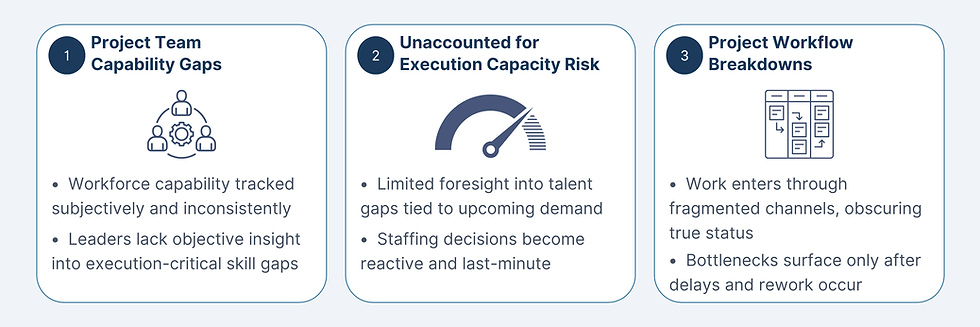
- Project team capability gaps: Leaders lack objective insight into execution-critical skill gaps
- Unaccounted for execution capacity risks: Leaders can’t foresee that their workforce is mismatched to its mission
- Project workflow breakdowns: Leaders can’t identify where execution bottlenecks occur until they experience delays
What we’ve come to realize is that delivery delays are driven less by planning failures and more by blind spots in project team capability, future workforce capacity, and execution visibility.
Our thesis is simple: If we want to go faster, if we want to accelerate project completion, and if we want to do that while spending less, we need to move beyond lagging indicators.
We need to equip project leaders with the leading indicators needed to identify, quantify, and prevent project delays and cost overruns.
We then asked our partners: “What are the diagnostic signals – the leading indicators – that equip you to accelerate project completion?
Again, we received clustered answers:
- Project team experience depth
- Capability-to-mission misalignment
- Behavioral and process blind spots
- Organizational discipline

Our work has taught us that execution risk becomes measurable when project leaders are able to look beyond cost and schedule.
Therefore, we set about building an asset-backed management approach – ProjectAccelerator – to give project leaders the decision-enablement solution they need to accelerate project completion while reducing costs. ProjectAccelerator was built to accelerate America’s next generation megaprojects. It’s been pressure-tested and proven on them.
Over the next few months, we’ll be writing about our firm’s evolving perspective on the underlying drivers of project delays and cost overruns, our diagnosis of where current approaches fall short, and I’ll begin describing how innovative, proven approaches like the ProjectAccelerator can equip American project leaders with what they need to deliver what past generations thought was impossible.



Comments